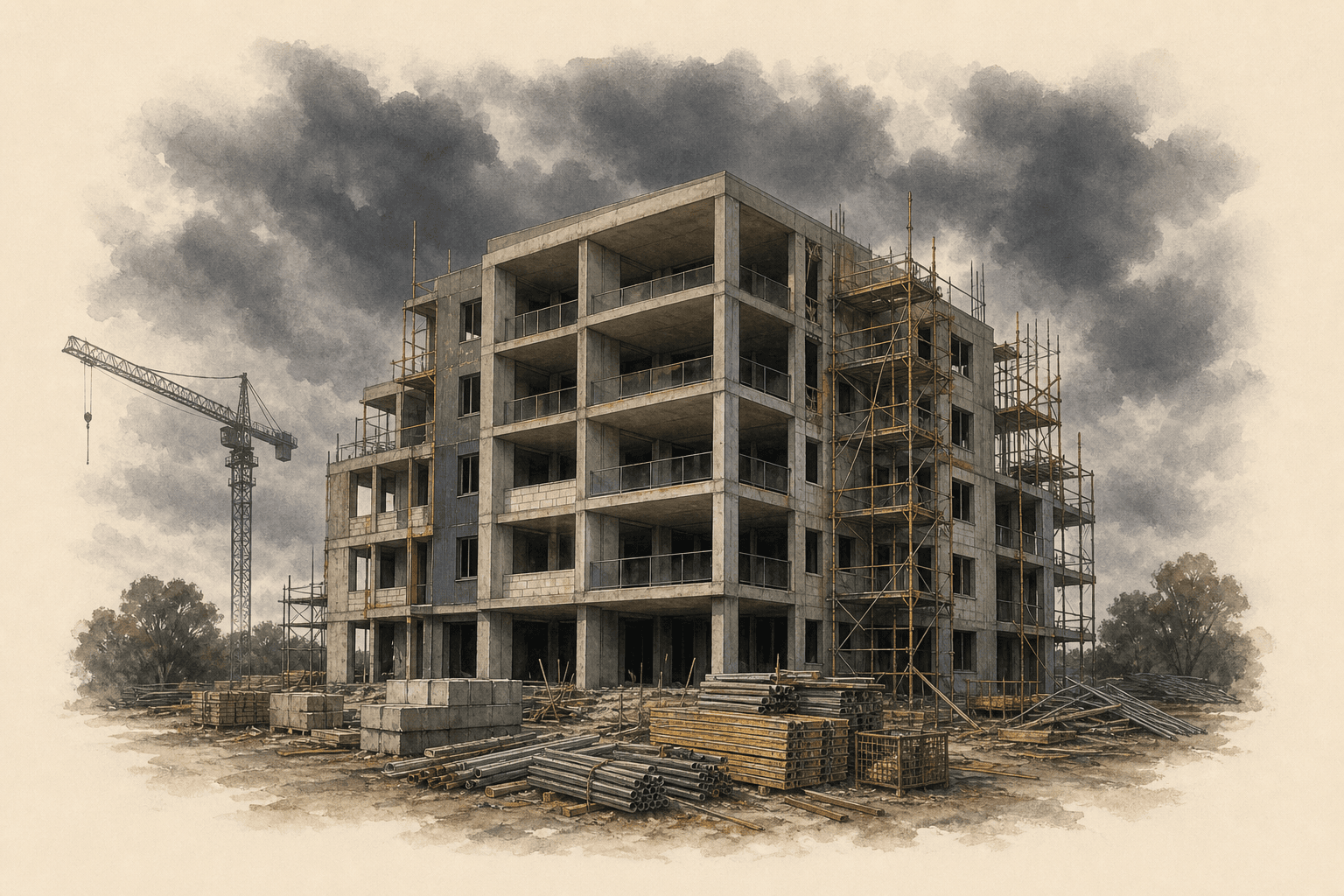
Two separate-looking headlines are actually describing the same situation from opposite ends. ASIC's insolvency statistics show builders accounting for 22–26% of all company collapses — well above construction's share of the overall business population. Meanwhile, the RBA's Financial Stability Review (March 2026) and Roy Morgan's February 2026 Mortgage Stress report count 1.41 million Australian households, or 26.6% of all mortgage holders, as financially stressed. Corporate story, household story — same transaction.
The place where those two things collide is the 4–8 storey apartment market. That's where builder margins are thinnest, where apartment prices relative to income are highest, and where off-the-plan contracts tie a struggling builder's finances to a stretched buyer's finances in ways that are hard for either side to get out of.
Why builders in this segment keep collapsing
The ASIC data (updated weekly, current to May 2026) shows builders leading all industries by total number of company failures and by share of all appointments. The underlying reason hasn't changed: fixed-price contracts signed in 2021 and 2022 locked in prices before material costs surged. Those contracts are still working their way through to final settlement. When the numbers don't add up, working capital dries up, disputes with subcontractors pile up, and tax debts stretch.
The most useful signal in the data isn't the total number of failures — it's the number of voluntary administration (VA) appointments among mid-sized residential builders in the $20 million to $100 million annual revenue range. A VA means a company in acute financial difficulty, mid-project, with an administrator trying to work out whether it can survive or needs to be wound up. For anyone who has signed an off-the-plan contract, a VA appointment on your builder is the scenario that most directly threatens your settlement.
The VBA Annual Report 2024-25 records a net fall in the number of registered builders in the residential medium-density class — meaning the firms that have collapsed haven't been replaced one-for-one by new ones entering the market.
Why apartments in the 4–8 storey range carry more risk
A large volume builder with fifty detached-home sites spread across different suburbs can absorb a failure without any single buyer bearing the full weight. A tier-one commercial contractor has diversified work and stronger financial backing.
Mid-rise apartment builders sit between those two cases, and it's not a comfortable spot. They're mid-sized, financially concentrated on a small number of projects. A single $30 million contract isn't a rounding error for them — it's a material chunk of their business. If that project's cashflow starts deteriorating, the whole company can be at risk.
If you've signed an off-the-plan contract in this segment, you've committed to a purchase — say $900,000 — and paid a deposit (often $90,000) into escrow before the building even exists. The deposit is contractually locked. Settlement is deferred but it's real and coming.
What financial stress looks like from the buyer's side
Roy Morgan counts a household as stressed when mortgage repayments exceed a set proportion of after-tax income, adjusted for household size and living costs. The February 2026 count of 1.41 million stressed households — 26.6% of all mortgage holders — is the buyer-side context for all of this.
The RBA's Financial Stability Review (March 2026) connects these two things directly. A buyer in financial stress has typically borrowed at the outer edge of what they could qualify for, relying on income assumptions that rate movements have since eroded. That same buyer is also the most likely to have bought off the plan in the mid-rise segment, because detached alternatives at a comparable price are scarcer. Someone who bought off the plan in 2023 or 2024 was typically at the outer edge of their borrowing capacity, relying on a valuation and a timeline that may no longer hold.
The builder serving that buyer is, per the ASIC data, operating in the segment with the highest insolvency rate. And the fixed-price contract that gave the buyer budget certainty is the same structure that puts the builder at risk from rising costs.
What actually happens if your builder goes into administration
If your builder enters voluntary administration mid-build, you don't automatically lose your deposit — deposits are typically held in escrow. What you lose first is your timeline.
A project in voluntary administration does not resolve in weeks. Working through creditor claims, deciding whether a deed of company arrangement is viable, and finding a substitute builder takes months. In practice, a twelve-to-eighteen month extension to the practical completion date is common when a project enters VA with significant work still outstanding.
During that period, you keep paying rent. Your mortgage pre-approval expires. The interest rate environment shifts. The RBA's Financial Stability Review notes heightened arrears risk among owner-occupier borrowers with off-the-plan exposure, specifically where completion delays interact with already-constrained borrowing capacity.
What the protections actually cover
The Victorian Building Legislation Amendment (Buyer Protections) Act 2025 introduced a developer bond scheme: a 2% cash bond on residential building projects of more than three storeys, held in trust and released at practical completion. For a $30 million project, that's $600,000 in bonded capital.
That's a real protection — but it's designed for defect rectification on a completed building, not for delivery failures. If a builder collapses before practical completion, the developer needs to find a substitute builder, recontract all the outstanding works, and cover the cost gap between the original fixed price and current market rates. Where construction costs have risen materially since those contracts were priced, that gap can be substantial.
Home warranty insurance covers the non-completion scenario too. But the path from builder entering VA to you settling on your apartment runs through multiple decision points that depend on the developer's own financial position and whether they can keep development finance running through the interruption.
The RBA FSR's assessment: protections are tighter than in 2022, but the gap between protection and exposure has not closed to zero.
The ABS Building Approvals data (8731.0) shows mid-rise approvals are still active in Victoria. The number of projects subject to the new bond requirements will grow before the insolvency rate comes down, if it does.
What this means for your property plans
If you've signed an off-the-plan contract for a mid-rise apartment, you're carrying three overlapping risks that move together, not independently.
Your builder's financial health affects whether and when you settle. Your own financial position affects how well you can absorb delays. The rate environment affects both.
Reading the ASIC insolvency data and the household stress data as separate issues misses the point. They're describing the supply side and the demand side of the same transaction in the same market. If you're in the stressed mortgage cohort, holding an off-the-plan contract in a mid-rise development, with a mid-sized builder operating under cost pressure — that's not a diversified position. It's three correlated risks at once. This is especially true for any Victorian mid-rise project contracted before mid-2023 that is still in delivery.
Understanding where your off-the-plan exposure sits relative to your overall financial position is the first step.
Marcus Chen writes on construction cost and builder risk. Every fact traces to a primary source. See our standards and corrections register.